
By : Altaf Abro
Nestled in the heart of Khairpur (Mirs), Sindh, Faiz Mahal stands not merely as a monument of the past but as a living witness to the glory of the Talpur dynasty and a shining emblem of Sindh’s rich cultural heritage. Built in 1905 by Mir Faiz Muhammad Khan Talpur I, this palace was originally envisioned as a royal court for the Talpur rulers. Over the period of time, it has seen the rise and fall of kingdoms, the merging of states, and the passage of time, each leaving its mark upon its noble walls.
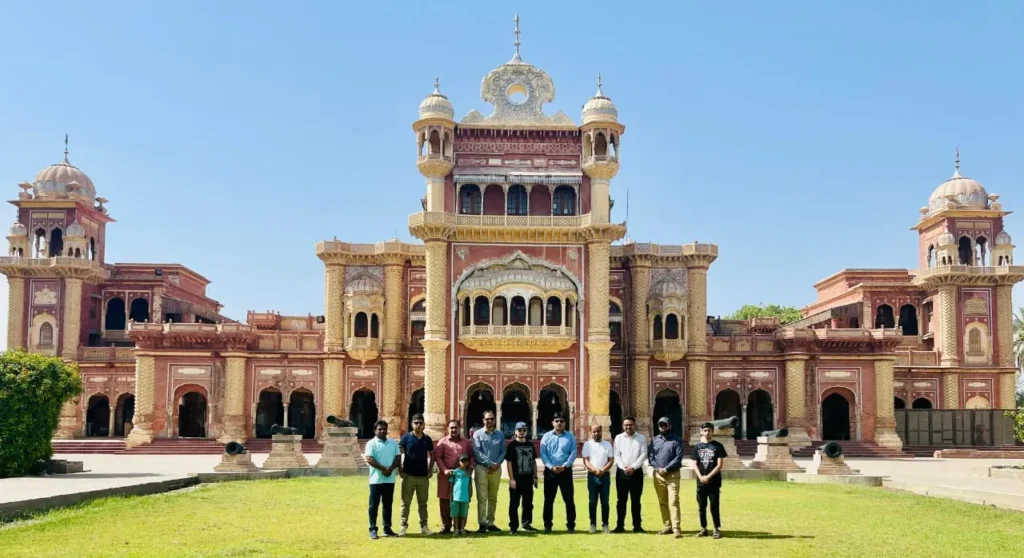
Once neglected for decades, Faiz Mahal has, in recent years, undergone remarkable restoration efforts. Today, it stands as a symbol of resilience and revival — a beacon of Sindh’s architectural and historical pride.
The Talpur dynasty, which ruled from 1783 to 1955, established its reign after dethroning the Kalhoras. Their rule ushered in an era of peace, prosperity, and cultural flourishing. Faiz Mahal, built during this golden age, served as the principal building of the royal palace complex, representing not just a royal residence but a manifestation of power, refinement, and vision.
Faiz Mahal embodies the fusion of Mughal, Rajasthani, and traditional Sindhi craftsmanship. Its pink and white façade, intricately carved pillars, and elegant arches recall a bygone era of luxury and grace. The balconies crowned with lotus-shaped domes showcase the skill and artistry of Talpur craftsmen.
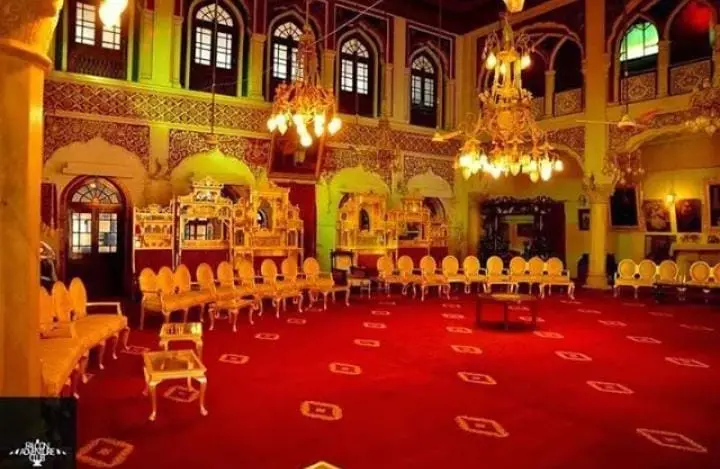
Inside, the palace was designed with both beauty and functionality in mind. The arched verandas open toward vast gardens, allowing sunlight and breeze to flood the interiors with warmth. The main Darbar Hall — a masterpiece of hand-painted ceilings and floral frescoes — once hosted royal courts and political deliberations of the Talpur rulers.
The palace once contained private chambers, royal waiting rooms, guest accommodations, and a grand dining hall. Surrounding the palace were acres of manicured lawns and gardens, meticulously maintained as symbols of the dynasty’s sophistication.
Within Faiz Mahal’s glass showcases lie letters, treaties, portraits, and relics that narrate the story of the Talpurs’ reign. The large portraits of Talpur rulers — adorned with ceremonial swords and attire — still exude an aura of authority and pride.
However, after the merger of Khairpur State with Pakistan in 1955, the palace fell into disrepair. It is said that under pressure and breach of agreement between His Highness Mir Ali Murad Khan Talpur II and Muhammad Ali Jinnah, Khairpur State was annexed — marking the beginning of a period of neglect and indifference toward its cultural heritage.
For decades, the palace walls crumbled, echoing only the silence of its former grandeur. Financial hardships of the Talpur family further delayed restoration.
In recent years, restoration efforts have breathed new life into Faiz Mahal. Recognizing its architectural and historical significance, careful work was undertaken to preserve both its structural integrity and artistic essence.
The revived lawns, the restored 18th-century cannons, and the revived Darbar Hall, with its luminous ceiling and historic displays, have reinstated Faiz Mahal’s former prestige. Yet, some modern additions — such as golden Victorian chairs, tiled floors, and electric ceiling fans — clash subtly with its historic aura, reminding us of the ongoing struggle between authenticity and modern preservation.
Today, His Highness Mir Ali Murad Khan Talpur II, now in his nineties, resides at Faiz Mahal with his sons, Prince Mir Abbas Raza Talpur and Prince Mir Mehdi Raza Talpur. Though the palace no longer serves as a seat of political power, it remains a symbol of the Talpur legacy and a monument of Sindh’s living heritage.
Mir Ali Murad Khan II, a passionate environmentalist, has dedicated his later years to conservation. He established the Mehrano Reserve, a sanctuary for endangered species such as blackbuck and hog deer, demonstrating the Talpurs’ lasting connection with the land.
Faiz Mahal is not merely a building — it is a repository of memories, echoing the laughter, elegance, and melancholy of eras gone by. The caretaker of the palace speaks with pride and sorrow about the downfall of the Khairpur Mirs’ political influence and the betrayal that led to their forced annexation.
The Zanan Khana (Women’s Quarters), once a secluded retreat for royal ladies, now serves as the residence of the Deputy Commissioner — a poignant symbol of how authority and purpose have shifted over time.
Faiz Mahal remains a cultural treasure, offering profound insight into Sindh’s artistic and historical past. Its architecture and preserved artifacts serve as invaluable educational resources for visitors and historians alike. Protecting and promoting this heritage site ensures that future generations continue to appreciate its significance.
In essence, Faiz Mahal is more than an architectural wonder — it is a symbol of endurance, heritage, and identity. Despite centuries of challenges, it continues to stand tall — a testament to the everlasting legacy of the Talpurs.
“Faiz Mahal”
In the golden sands of Sindh, at the heart of Khairpur Mirs, a poem in stone stands a dream carved in pink stone.
Mir Sahib, after a devastating flood, envisioned not just a palace of power,
but a crown of beauty and art.
Foundations sunk twelve feet deep,
iron sheets laid to resist earthquakes;
pink stones brought from Jamshoro,
each slab four feet thick, thirty-five feet high —
and atop them, 18th-century cannons engraved with flowers that still gleam today.
Through the grand 18-foot gate, the royal Darbar Hall opens before you —
an 80×50-foot expanse where the Mir once read decrees upon a golden throne.
A teak ceiling above, a twelve-foot chandelier below,
walls adorned with Persian tilework,
where sunlight dances through stained glass like a living rainbow.
Beyond lies the Zanana Mahal — a fragrant, private world of twelve painted chambers,
ivory lattice windows whispering secrets of royal life,
and a small fountain still breathing the scent of rosewater and time.
The guest wing, with sixteen rooms, hosts teak beds, ivory mirrors, and Persian carpets,
overlooking the Garden of Faiz, where jasmine and roses bloom
and peacocks roam free.
The copper-plated roof — three inches thick —
has endured for over two centuries,
singing in the rain, gleaming under the moon.
Water drains into underground tanks;
108 marble pillars, carved with birds and blossoms,
reflect the sun’s brilliance in Makran’s white stone.
Construction began in 1898 and completed in 1905.
At dusk, as the call to prayer echoes, chandeliers glow,
and the copper roof shines under the moon,
it feels as though history itself breathes once again.
Faiz Mahal is not merely a monument — it is a living poem etched in stone.
Conversation with Prince Mir Mehdi Raza Talpur
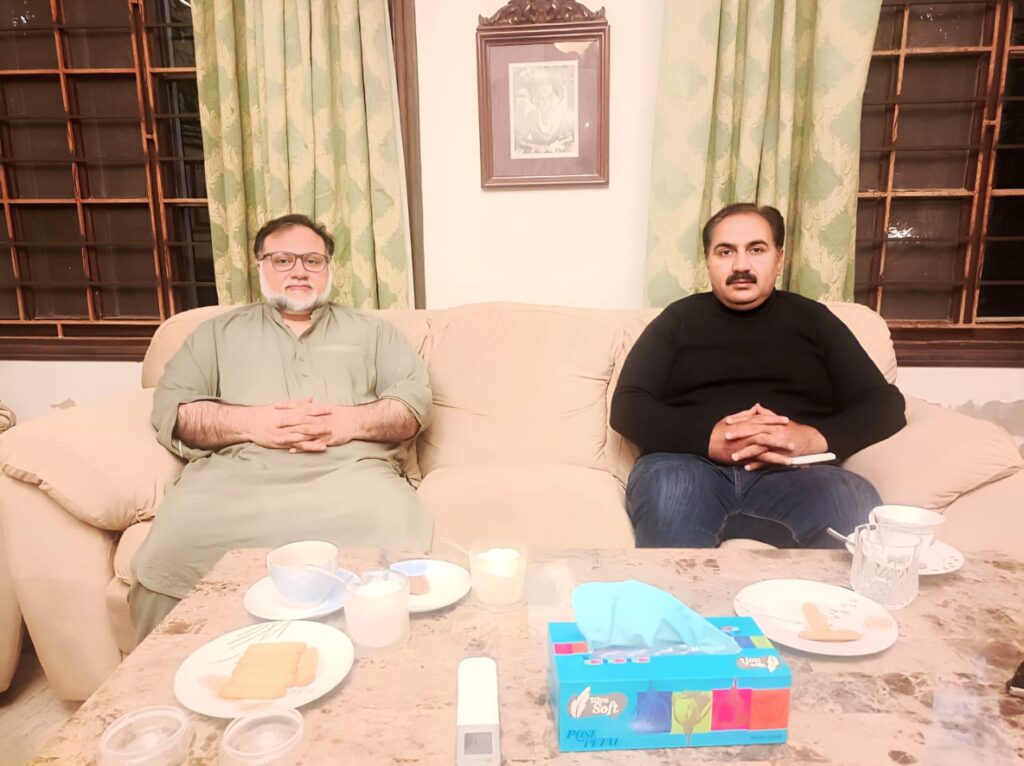
In the Presidential Chamber of Faiz Mahal, I met Prince Mehdi Raza Talpur, son of His Highness Mir Ali Murad Khan Talpur II — a man of deep knowledge, wide intellect, and humble charm.
When asked about royal protocol, the Prince smiled People still greet me as a prince, as if I were a ruler,” he said.
“But I feel sorrow — crime and land-grabbing have increased so much here that I feel helpless when someone complains. I neither have, nor seek, any protocol. Power is a curse; one mistake in governance can lead a man straight to hell.”
He continued If the agreements made by Quaid-e-Azam had been honored, Khairpur would have surpassed England or Dubai. We were advancing when England was still riding horses. I received my early education in England and higher education in America, living peacefully — until land mafias began encroaching on our ancestral property. My father grew old, and I had to return.”
He proudly showed the Darbar Hall, adorned with historical portraits and invitations — including visits by President Ayub Khan, Prime Minister Liaquat Ali Khan, and Begum Ra’ana Liaquat Ali Khan. A portrait of Mir Faiz Muhammad Khan Talpur meeting the King of England in 1909 hangs beside the original written agreement with Quaid-e-Azam, which sadly was never implemented.
My father was crowned at the age of 14,” the Prince said.
“Khairpur was a 19-gun salute state. The British reduced it to 15 out of resentment. Look at Dubai or Qatar — they were smaller principalities, yet see how they have prospered.”
He added that the palace complex covers over 12 acres, including what is now the Deputy Commissioner’s House, once part of their residence called Dil Kashah Manzil, with adjoining royal garages.
Faiz Mahal has 36 rooms and 18 waiting chambers,” he explained.
“One of them is the Presidential Chamber, where the President of Pakistan was meant to visit once a year, as per the annexation agreement — but that promise, too, remains unfulfilled.”
Notable Rulers of the Talpur Dynasty
Mir Sohrab Khan Talpur — Ruled 1783–1811
Mir Rustam Khan Talpur — Ruled 1811–1843
Mir Ali Murad Khan Talpur I — Ruled 1843–1894
Mir Faiz Muhammad Khan Talpur I — Ruled 1894–1909
Mir Imam Bakhsh Khan Talpur — Ruled 1909–1922
Mir Ali Nawaz Khan “Naz” Talpur — Ruled 1922–1935
Mir Faiz Muhammad Khan Talpur II — Ruled 1935–1947
Mir Ali Murad Khan Talpur II — Ruled 1947–1955
It was Mir Ali Murad Khan Talpur II who, in 1955, signed the agreement that merged Khairpur State with Pakistan — an event that closed one chapter of sovereignty but opened another of legacy.
Faiz Mahal, even today, stands as a poetic relic of power, art, and endurance —
a timeless reminder that history never truly fades; it only waits to be remembered.

